|
|
|
|
STUDY ON REAL ESTATE ECOSYSTEM AND CLIENT ENGAGEMENT
Yash Pradip Gaikwad 1, Dr. Reshma Nair 2, Dr. Bhawna Sharma 3
1 BBA
Student of Amity Business School, Amity University Mumbai, Mumbai, India
2 Associate
Professor, Amity Business School, Amity University Mumbai, Mumbai, India
3 Director International Affairs and Programs, Officiating HOI, Amity
Business School, Amity University Mumbai, Mumbai, India
|
|
|
ABSTRACT |
|
|
The real
estate ecosystem in India has undergone a significant transformation in
recent years due to rapid urbanisation, regulatory reforms, and increasing
consumer awareness. However, despite this evolution, challenges such as
inconsistent documentation, opaque dealings, and the rise of non-compliant
intermediaries continue to erode customer trust. This research examines the
structural, operational, and behavioural dimensions of the real estate
ecosystem, with a specific focus on understanding how client engagement
influences decision-making, transaction transparency, and overall market
stability. Through an analytical assessment of consultancy practices,
customer interaction models, and service delivery patterns, the study
identifies the key determinants that shape buyer confidence and long-term
satisfaction. The paper also evaluates the strategic role of real estate
consultants in bridging information gaps, mitigating risks, and fostering
ethical, client-centric practices. The findings highlight that effective
engagement—characterised by communication clarity, credibility, and verified
knowledge—significantly enhances trust, reduces hesitation, and promotes
sustainable real estate participation. This study ultimately contributes to
the growing literature on real estate professionalism by emphasising the need
for structured engagement frameworks that align market growth with ethical
responsibility. |
|||
|
Received 28 April 2025 Accepted 29 May 2025 Published 30 June 2025 DOI 10.29121/ShodhSamajik.v2.i1.2025.48 Funding: This research
received no specific grant from any funding agency in the public, commercial,
or not-for-profit sectors. Copyright: © 2025 The
Author(s). This work is licensed under a Creative Commons
Attribution 4.0 International License. With the
license CC-BY, authors retain the copyright, allowing anyone to download,
reuse, re-print, modify, distribute, and/or copy their contribution. The work
must be properly attributed to its author.
|
|||
|
Keywords: Real Estate Ecosystem, Client Engagement |
|||
1. INTRODUCTION
Real estate plays a very intrinsic role in the shaping of economic growth, urban development, and social welfare. The industry, though one of India's fastest-growing sectors, goes way beyond mere housing and infrastructure to permeate all aspects of financial markets, construction networks, and patterns of investment and employment. Nevertheless, the real estate ecosystem in India is still inherently complicated and fragmented, comprising multi- stakeholders-developers, consultants, brokers, government agencies, financial institutions, and buyers-whose interactions define the transparency and efficiency of the whole system. In recent years, the sector has also undergone unprecedented scrutiny due to unethical practices, misleading documentation, and irregular transactions which has significantly hit customers' trust and purchasing confidence.
Therefore, client engagement has become an important factor in recent years within the modern real estate scenario. With greater access to digital information and awareness of legal and financial risks, today's clients would seek clarity, credibility, and responsiveness at each stage of the property transaction. The traditional sales-oriented approaches are gradually giving way to consultation-based engagement models, ethical guidance, and validated decision-making. This shift underlines the importance of real estate consultants-people who can bridge the gap in information and ensure regulatory compliance.
However, certain discrepancies in customer expectations versus actual service delivery are still evident in the market today. Buyers often face incomplete documentation, inconsistent communication, exaggerated claims, and a lack of transparency-all factors encouraging caution and slowing down investment activity. Therefore, the need for a structured, ethical, and client-centric engagement framework has become more pressing than ever.
The research focuses on the dynamics between the real estate ecosystem and the engagement mechanisms that shape customer experiences. It examines how operational challenges, behavioral factors, and consultancy practices serve in sustaining trust, reducing uncertainties, and enabling effective communication that ultimately drives buyer decisions. Furthermore, this research reviews how modern consultancy firms are able to rebuild customers' confidence with valid information, professionalism, and a systematic check of the details of properties.
In so doing, the research adds to existing debates on real estate professionalism, moral accountability, and market change. The authors also give prominence to the growing importance of client engagement as not only a business strategy but also as structural imperative if the industry is to be more transparent, raise service quality, and support sustainable property development.
2. CUSTOMER PREFERENCE AND BEHAVIOURAL PATTERN
Customer preference and behavioral trends have taken center stage in understanding the changing dynamics of the real estate industry. In an increasingly competitive and information- driven market, buyers no longer base their decisions solely on aspects of price or location; instead, their choices reflect a complex interaction of emotional, financial, social, and experiential factors. With greater digital access, rising awareness of legal compliance, and change in lifestyle expectations, customers assess properties through a multidimensional lens, considering not only structural features but also credibility, sustainability, connectivity, and long-term value.
Over the last ten years, a fundamental evolution has occurred in customer behavior within the Indian real estate market. Today, customers are more interested in verified information, transparent communication, and professional consultations from experts before making a decision about purchasing a property. Their preferences will be influenced by exposure to several competing properties, peer reviews, social media influence, and personalized needs that include proximity to places of work, accessibility to amenities, safety standards, and others that would fall under feasibility. Real estate decisions are now becoming increasingly informed, emotionally balanced, and aware of risk, like never before.
These behavioral changes are driven by growing distrust about unregulated intermediaries and misleading practices in the market. Delays in possession, hidden charges, and incomplete documentation in the past have left customers more aware, analytical, and interested in ethical consultants who can give them transparent advice. Increased due diligence, repeated cross- verification, and preference for credible platforms or agencies define the behavior of a customer. This has redefined the roles of consultancy firms, focusing the spotlight on credibility, communication capabilities, and personalised customer service.
In this regard, deciphering these behavioral patterns will not only prove invaluable but also become indispensable to upgrade service delivery and align market offerings with customer requirements. For firms, there is a definite need to appreciate the myriad of psychological triggers that determine buyer choices, from family aspirations and lifestyle needs to perceived risk and financial planning. As such, emerging patterns of customer engagements must adjust to these newfound truths whereby interactions foster confidence and minimize uncertainty while promoting informed decision-making. This research focuses on understanding the nature of behavioral disposition that shapes customer actions in real estate markets, with a significant degree of focus on how trust, transparency, communication, and perceived value impact buy or rent decisions. By investigating preference determinants and factors of hesitation, this research emphasizes the importance of structured models of engagement and ethical consultation in guiding customers through complicated property transactions.
3. REVIEW OF LITERATURE
Gupta 2017, Determinants of Homebuyer Preferences
Gupta looked at the changing homebuyer priorities in metropolitan cities and noted that contemporary customers put lifestyle compatibility, work place connectivity, and long-term financial value ahead of other traditional factors such as the size of the house or family influence. The increased exposure to online property portals was noted to have shaped customer expectations a great deal since the ability to compare multiple projects before making a final decision is now possible. It concluded that convenience, accessibility, and perceived future appreciation remain core determinants of buyer preference.
Ramanathan and Bose (2019) - Customer Trust and Market
Hesitation
They mentioned that, largely due to incomplete documentation, hidden charges, and delays in the project, trust deficits exist in the real estate market. Customers show more reluctance and do more cross-verification prior to contacting developers or consultants, their research showed. They suggested that transparent communication, verified documentation, and ethical consultation play an essential role in reducing buyer uncertainty and encouraging proactive engagement.
Kulkarni, 2020 - Impact of digital information on buyer
behaviour
Kulkarni's study focused on the role that digital platforms, social media, and online reviews play in shaping customer expectations. Among his findings was the fact that a majority of urban buyers considered doing online research as their starting point in property exploration. With virtual tours, peer feedback, and tools for comparing projects having gained common ground, decision-making has become more analytic and data-driven. In effect, customers are less influenced by traditional sales pitches and more dependent on objective, factual information.
Sengupta and Iyer (2021) - Behavioural Economics in
Real Estate Decisions
This study applied behavioral economics to real estate choices and demonstrated that emotional triggers-security, social status, and lifestyle aspiration-are still major drivers of choice. The authors found that customers often trade off rational considerations (pricing, EMI feasibility, layout efficiency) for psychological needs for comfort, prestige, and community belonging. The study concluded that firms should consider both the emotional and rational dimensions in engaging their clients by providing a holistic decision-support framework. Das and Trivedi, 2022: Buyer Perception and the Role of Consultants Das and Trivedi underlined the role of real estate consultants in shaping buyer perceptions by reducing information asymmetry. Their findings showed that customers like consultants who manifest professional behavior, communicative transparency, and knowledge of legal and financial requirements that can be verified. The study underlined that ethical consultancy increases buyer confidence and satisfaction, especially in markets with a history of distrust. Mukherjee (2023) –
Behavioural Shifts Post Regulatory Reforms (RERA) Mukherjee studied the change in customers' behavior after RERA came into implementation. The buyers became more assertive, compliance-focused, and documentation-oriented. Buyers increasingly demand clarity on legal approvals, construction timelines, dates of possession, and financial breakdowns. Overall, this change pushed developers and agents to a more structured and transparent method of engagement, which eventually heightened the entire behavioral landscape of the sector.
4. METHODOLOGY
This study adopted a descriptive and analytical research approach to understand the functioning of the real estate ecosystem and client engagement practices within Velosit India Pvt. Ltd. The methodology combines primary as well as secondary data sources to present a holistic understanding of market behaviour, customer preferences, and operational processes.
Primary data was collected through direct observation during the internship, where real-time interactions with customers, channel partners, and sales teams helped in understanding on- ground challenges and engagement strategies. Discussions with my company guide, Mr.
Saish, and other team members provided practical insights into client handling, lead conversion, documentation needs, and consultancy ethics. Field exposure at the Godrej One project site (Vikhroli) further strengthened the understanding of customer queries, objections, and decision-making triggers.
Secondary data was gathered from industry reports, RERA guidelines, government policies, real estate research papers, and company brochures. These sources helped in analyzing market patterns, regulatory frameworks, and ecosystem trends.
The collected data were then systematically organized, compared, and interpreted to identify patterns related to customer behavior, industry practices, operational challenges, and ethical considerations. The combination of qualitative observation and document-based analysis ensures credibility, relevance, and accuracy in the study's findings.
5. ANALYSIS AND DISCUSSION
The internship with Velosit India offered work exposure both from a strategic and a customer- oriented approach toward real estate consultancy operations. Your direct involvement in the communication management, lead handling, and client engagement aspects of the Godrej One project in Vikhroli deeply constitutes the backbone of sales performance in real estate. This experience allowed you to analyze how customers make decisions, what concerns dominate their thinking, and how transparency and timely guidance influence their confidence levels.
The interactions showed that customers today are way more informed and cautious, especially with the increasing number of fraudulent cases and incomplete documentation in the general industry. Therefore, the clients would need clear communication, verified information, and regular follow-ups before any site visits or financial considerations. In this regard, discussions with prospects pointed out how locational advantages, amenities offered by a project, corporate connect, and price flexibility have played a major role in shaping buyer preference for premium residential complexes such as Godrej One.
Operationally, the internship showed that there is always a need for internal coordination within Velosit. Communication between the sales team, channel partners, and documentation staff had to be ensured to provide clients with the exact details on time. The experience also brought forward challenges in the form of intense competition from larger firms, fluctuating market sentiment, and delays in customer decision-making that affect the overall efficiency of real-estate operations.
This analysis also revealed that the strength of Velosit lies in the personalized model of engagement and the ethical way of conducting consultations, which helps bridge the credibility gap in this line of business. Discussions with customers indeed showed that trust, professionalism, and clear communications are major differentiators in such a highly competitive market. In summary, the internship allowed for a deeper insight into how real- estate consultancy works, how customer preferences mold the sales cycle, and why effective communication remains the most critical element in the conversion and satisfaction of clients.
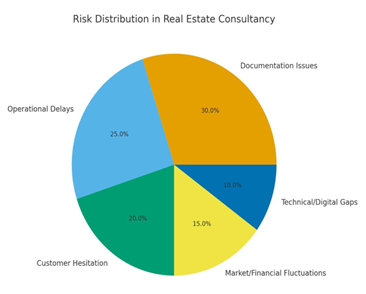
6. FINDINGS (Based on Risk Frequency & Impact in Real Estate Consultancy)
1) Documentation & Verification Risk emerged as the greatest concern, mainly due to incomplete paperwork, incorrect project details shared by clients, and delays in collecting essential documents such as Aadhar, PAN, financial proofs, and loan sanction files. These issues directly slowed down the onboarding and booking process, often resulting in postponed client decisions and reduced conversion efficiency.
2) Operational Communication Risk was the second-highest, especially involving coordination gaps between channel partners, site teams, and client servicing executives. Misalignment in meeting schedules, delay in responding to queries, and inconsistent follow-ups created friction in the sales funnel, leading to slower lead maturity and occasional client drop-offs.
3) Customer Hesitation & Trust Risk also appeared significantly high, primarily due to market uncertainty, fear of fraudulent deals, and doubt regarding RERA compliance. Clients often required multiple assurances and cross-verification, increasing the time needed to convert prospects into bookings.
4) Market & Financial Fluctuation Risk showed moderate impact, especially with rising property rates, changes in stamp duty guidelines, interest rate variations, and promotional offer fluctuations. These factors influenced affordability perceptions, sometimes diverting clients to alternative projects or delaying decisions.
5) External Environmental Risk was relatively low but present, driven by factors like changes in government regulations, infrastructure development delays, or hyperlocal political influences. These factors indirectly shaped buyer sentiment and market movement but did not affect daily operations drastically.
6) Technical & Digital System Risk was the lowest, though occasional CRM update delays, website inconsistencies, and limited digital integration affected response efficiency. While these disruptions were minor, they still influenced the speed and clarity of client communication.
7. CONCLUSION
The research on the real estate ecosystem and customer engagement with Velosit India shows the circuitous yet highly opportunistic nature of the sector, especially within metropolitan cities like Mumbai. The internship provided comprehensive insight into how communication, customer management, documentary accuracy, and market awareness together shape the performance of a real estate consultancy firm through hands-on exposure at the Godrej One project. The findings underlined that real estate operations are deeply enmeshed with transparency, ethical consultation, and continued relations that impact buyer confidence in a market sustained by misinformation and problems related to documentation.
The analysis also outlined that communication-based inefficiencies, operational delays, and incomplete documentation remain some of the most frequent risks in the consultancy process. However, strong client engagement strategies, structured channel partner coordination, and the adoption of digital tools can effectively minimize many of these challenges. In fact, the role of Velosit stood out as a major contributor to customer satisfaction and effectiveness in service by bridging the trust gap through verified information, guided property visits, and simplified documentation. Gaining a deeper understanding of such processes from a trainee's perspective proved useful for understanding the levers of credibility and personalization driving customer decisions.
Lessons from market fluctuations, regulatory constraints, and changing buyer expectations all serve to underpin that the need for constant evolution, innovation, and compliance with government regulations is a matter of real estate consultancies. The study concludes that long- term growth in the real estate consultancy model has to be balanced between profitability, ethical conduct, and customer-centric approaches. Companies such as Velosit must extend operational reach but also refine digital presence, improve data management systems, and promote skill development within teams for sustainable competitiveness.
Generally speaking, the internship was a source of transformation in terms of exposure to the way clients are dealt with, sales operations are conducted, risks are identified, and the way strategy is communicated. It enhanced the technical and interpersonal competencies and brought more clarity with regard to how consultancy firms function within the broad perspective of the real estate sector. The study, therefore, confirms that ethical consultancy, open communication, and structured customer relationship are key pillars for engendering trust and ensuring enduring success within the Indian real estate sector.
CONFLICT OF INTERESTS
None.
ACKNOWLEDGMENTS
None.
REFERENCES
EY India. (2022). Emerging Trends in Real Estate Development and Consultancy Services.
Godrej Properties Reports. (2024). Company Brochure, Location Analysis & Customer Engagement Metrics.
JLL Research. (2023). Customer Behaviour and Residential Housing Insights in Indian Metro Cities.
KPMG India. (2023). Indian Real Estate: Vision 2040 — Sectoral Growth, Trends & Forecasts. Retrieved
Knight Frank India. (2022). Real Estate Investment and Market Demand Report.
Ministry of Housing & Urban Affairs (MoHUA). (2022). Real Estate Regulatory Policies and Urban Development Guidelines.
NITI Aayog. (2023). Urban Infrastructure Expansion – Mumbai Metropolitan Region (MMR) Development Blueprint.
National Housing Bank (NHB). (2023). Indian Real Estate Market Overview and Housing Report.
PwC India. (2023). Real Estate Outlook — Investment Trends & Buyer Behaviour in Tier-I & Emerging Markets.
RERA Maharashtra. (2023). Regulatory Framework, Project Registrations & Customer Protection Mechanisms.
RICS (Royal Institute of Chartered Surveyors). (2021). Ethics and Transparency in Global Real Estate Markets.
Velosit India Pvt. Ltd. (2024). Internal Documentation & Sales Communication Insights (Primary data collected during internship).
|
|
 This work is licensed under a: Creative Commons Attribution 4.0 International License
© ShodhSamajik 2025. All Rights Reserved.