|
|
|
|
Original Article
The Role of Education in Perpetuating or Reducing Social Inequality: A Comparative Analysis Across Socioeconomic Groups with Case Studies from Sweden, the United States, and South Africa
|
Stephen
Guduza 1*, Molaodi Tshelane 2 1 Department of Curriculum
and Instructional Studies, College of Teacher Education College of Education, University of
South Africa, Republic of South Africa 2 Department of Curriculum and Instructional
Studies, College of Teacher Education College of Education, University of South
Africa, Republic of South Africa |
|
|
|
ABSTRACT |
||
|
Education is widely considered a central mechanism for social mobility, yet evidence shows that it can also reproduce socioeconomic inequality. This article examines the dual role of education through a comparative analysis of Sweden, the United States, and South Africa, integrating insights from human capital theory, social reproduction theory, and critical political economy. Drawing on large-scale assessment data, policy documents, and household surveys (2018–2023), the study investigates how governance structures, resource allocation, and historical legacies shape the capacity of education systems to mitigate or entrench inequality. Findings indicate that Sweden’s welfare-oriented, centrally coordinated system reduces SES-related disparities, whereas the United States decentralised and market-driven model exacerbates stratification, particularly along racial and economic lines. In South Africa, the persistence of apartheid-era spatial and resource inequalities continues to limit the equalising potential of education. The article concludes that education’s impact on social inequality is contingent on political, economic, and institutional contexts, highlighting the need for deliberate policy interventions to achieve equitable outcomes. Keywords: Education Inequality, Social Mobility,
Comparative Education, Socioeconomic Status (SES), South Africa, PISA, School
Funding, Case Study |
||
INTRODUCTION
Education is
widely regarded as a cornerstone for promoting social mobility and providing
equal opportunities for all individuals, regardless of their social or economic
background. Yet, extensive research demonstrates that students from
low-socioeconomic status (SES) households continue to experience lower academic
achievement, reduced access to tertiary education, and limited opportunities in
high-skilled labour markets, contributing to the reproduction of
intergenerational inequality OECD. (2023), OECD. (2025). This paradox challenges the assumption that
schooling is inherently an equalising institution and raises critical questions
about the structural and historical factors that shape educational outcomes.
Human capital
theory frames education as an investment in knowledge and skills that yields
economic returns, implying that broader access should reduce inequality Becker
(1993). However, evidence shows that educational
attainment alone does not guarantee equitable outcomes, as returns to education
are shaped by family background, institutional quality, and labour-market
structures. Social reproduction theory offers a complementary perspective,
highlighting how education systems often reproduce pre-existing social
hierarchies by privileging the cultural, social, and economic capital of
dominant groups Bourdieu (1986), Bowles
and Gintis (1976).
Comparative
research further illustrates that education’s capacity to promote equity is
context dependent. In Sweden, a centrally coordinated welfare-oriented system
has historically narrowed SES-related achievement gaps through sustained public
investment and redistributive policies, though emerging challenges from
marketisation and school choice remain Lundahl
(2024). In the United States, decentralised
funding, residential segregation, and racial inequalities continue to reinforce
socioeconomic stratification Reardon
(2025). South Africa presents a post-colonial
context in which apartheid-era policies created deeply unequal schooling
structures. Despite formal equity-oriented reforms, spatial segregation and
unequal distribution of resources persist, constraining the system’s ability to
reduce inequality Soudien (2024), Köhler (2024).
This article
examines the dual role of education in perpetuating or reducing social
inequality by integrating empirical evidence from large-scale assessments,
policy documents, and household surveys with theoretical insights from human
capital theory, social reproduction theory, and critical political economy.
Through a comparative lens, it investigates how governance structures,
historical legacies, and resource allocation shape the distributive outcomes of
education, offering a nuanced understanding of when and how schooling can
function as an instrument of social mobility or a mechanism of stratification.
Research Questions
Main Research Question:
·
How do
education systems in Sweden, the United States, and South Africa contribute to
either the reduction or perpetuation of socioeconomic inequality?
Sub-questions:
·
How do
governance structures, funding models, and historical legacies shape the
capacity of each education system to promote equity?
·
In what
ways do socioeconomic status and associated cultural and social capital
influence educational outcomes across the three contexts?
·
How do
policies and institutional practices in each country interact with historical
and contemporary inequalities to affect students’ access to high-quality
education?
·
What
lessons can be drawn from comparative analysis to inform policy interventions
that strengthen education’s potential as a tool for social mobility and equity?
Significance of the Study
This study is
significant for several reasons. First, it addresses a pressing global and
national concern: the persistent reproduction of social inequality through
education. In South Africa, which ranks among the most unequal societies
worldwide (Gini coefficient = 0.63; Stats SA, 2023), understanding how
schooling either mitigates or perpetuates disparities is critical for fostering
post-apartheid social cohesion and inclusive development.
Secondly, adopting
a comparative perspective that includes Sweden and the United States, the study
situates South Africa’s education system within a broader global context,
highlighting how governance structures, funding models, and historical legacies
interact with socioeconomic status to produce differing equity outcomes. This
approach provides actionable insights for policymakers, enabling cross-context
learning while recognising the specificity of post-colonial and racialised
inequalities.
Thirdly, the study
integrates human capital theory, social reproduction theory, and critical
political economy to provide a multidimensional analytical lens on education
and social inequality. Human capital theory is employed to explain how
investments in education shape skill acquisition, productivity, and individual
economic returns, highlighting education’s potential to promote social
mobility. Social reproduction theory foregrounds the ways in which cultural,
social, and economic capital are differentially transmitted across
socioeconomic groups, illuminating how schooling can reproduce existing class
hierarchies. Critical political economy extends this analysis by situating
educational processes within broader structures of power, governance, and resource
allocation, drawing attention to the role of state policy and market forces in
shaping educational opportunity. Taken together, these frameworks enable a
nuanced understanding of the mechanisms through which education both mitigates
and entrenches social stratification across different national contexts.
This contributes
both to academic debates on educational inequality and to evidence-informed
strategies for achieving more equitable educational outcomes in highly unequal
societies.
Finally, the
research highlights the conditions under which education can function as a
genuine vehicle for social mobility, providing guidance for interventions aimed
at reducing intergenerational inequality and promoting more inclusive, just,
and cohesive societies.
Theoretical Framework
This study draws
on a multi-theoretical lens to interrogate the dual role of education in
reproducing or reducing social inequality. Integrating human capital theory,
social reproduction theory, and critical political economy, the framework
situates schooling within broader social, historical, and institutional
contexts. These theoretical perspectives provide complementary explanations for
how education mediates socioeconomic outcomes and allow for comparative
analysis across Sweden, the United States, and South Africa.
Social Reproduction Theory
Social
reproduction theory emphasizes how education systems perpetuate existing social
hierarchies by privileging the cultural, social, and economic capital of
dominant groups. Bourdieu
(1977) introduced the concepts of cultural capital
and habitus, arguing that schooling reproduces class structures by rewarding
the knowledge, dispositions, and linguistic practices of middle- and
upper-class students. Lareau
(2023) work on concerted cultivation extends this
framework to contemporary settings, demonstrating how family-mediated
advantages in language, cognitive stimulation, and institutional navigation
reinforce differential educational outcomes. In the context of South Africa, Spaull (2021) two-tiered system model illustrates how
historically under-resourced schools continue to constrain social mobility,
highlighting the interplay of race, class, and school quality in reproducing
inequality. This theory directly informs Research Questions 3 and 4, focusing
on how SES, cultural capital, and family background shape educational
attainment.
Compensatory and Human Capital Theory
Compensatory
theories of education, rooted in Coleman et al.’s (1966) analysis of schooling
and family background, posit that high-quality public education can mitigate
the disadvantages associated with low SES. Complementing this, human capital
theory Becker
(1993) frames education as an investment in
knowledge and skills that yields measurable returns in the labour market.
Together, these perspectives suggest that equitable access to quality schooling
and skill acquisition can reduce inequality by enhancing the productivity and
employability of disadvantaged learners. In comparative terms, these frameworks
illuminate why centralised, well-resourced systems (e.g., Sweden) may achieve
higher equity, while decentralised or market-driven systems struggle to
compensate for structural disadvantage. Human capital and compensatory
perspectives underpin Research Questions 1 and 3, highlighting the mechanisms
through which education can generate social mobility.
Critical Political Economy and Institutional Theory
Critical political
economy situates education within the broader distribution of power, resources,
and governance structures. Esping-Andersen
(2004) welfare state regimes framework demonstrates
that the institutional arrangements of social and education policy shape the
distributional outcomes of schooling. Neoliberal reforms, decentralised
funding, and marketisation trends often exacerbate inequality by enabling
opportunity hoarding and differential access to quality education (Ball, 2023;
Verger et al., 2024). In South Africa, post-apartheid policy reforms are
constrained by historical spatial and resource inequalities, limiting the
state’s ability to redistribute opportunities equitably Köhler (2024), Soudien (2024). This perspective is central to Research
Questions 2 and 4, emphasizing how governance, funding, and structural
conditions mediate the capacity of education systems to reduce or reproduce
inequality.
Integrative Perspective
By synthesising
social reproduction, compensatory/human capital, and critical political economy
theories, this study develops a nuanced framework for understanding how
education interacts with family background, institutional design, and state
policy to produce differential outcomes. This integrative approach allows for
cross-national comparison, highlighting the interplay of historical legacies,
policy frameworks, and socioeconomic stratification in shaping the equity and
effectiveness of education systems. It provides the theoretical grounding for
examining how and why education can function as both a mechanism for social
mobility and a vector of inequality, particularly in contexts characterised by
deep structural disparities.
|
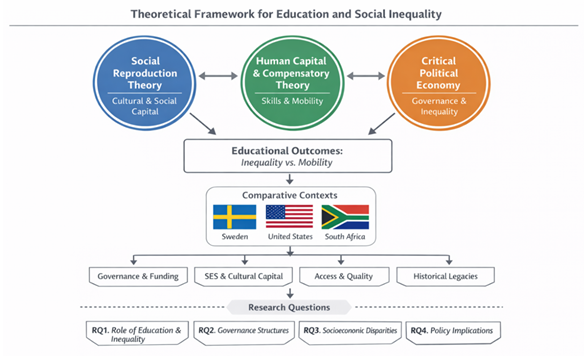
Figure 1
|
|
Figure 1 Theoretical Framework for Educational
Inequality |
Key for Figure 1. The conceptual diagram uses color-coded
circles to represent the three theoretical strands: blue for Social
Reproduction Theory, green for Human Capital & Compensatory Theory, and
orange for Critical Political Economy. Arrows illustrate the influence of each
theoretical perspective on educational outcomes, highlighting the flow from
theory to practice. The central box depicts “Educational Outcomes: Inequality
vs. Mobility,” showing how theoretical mechanisms interact to shape learning
and opportunity. National context blocks (Sweden, United States, South Africa)
indicate the comparative settings, with mediating factors—such as governance,
funding, SES, cultural capital, and historical legacies—shown as connecting
pathways between theory and outcomes. Research Questions (RQ1–RQ4) are mapped
to demonstrate the alignment of each theory with the specific analytical focus,
ensuring a clear visual representation of how the study investigates the dual
role of education in perpetuating or reducing social inequality.
Methodology
Comparative Case Study Design
This study employs
a comparative case study design to investigate the dual role of education in
either reproducing or mitigating social inequality across diverse national
contexts. Comparative case studies are particularly suited for exploring
complex, context-sensitive phenomena because they allow for systematic,
in-depth analysis of how historical legacies, policy frameworks, institutional
arrangements, and socioeconomic structures shape educational outcomes Ragin (2014), Yin (2018). By selecting cases that vary in inequality
levels, governance structures, and historical trajectories, the study maximizes
theoretical variation, enabling nuanced insights that can inform both
comparative theory and context-specific policy interventions.
The three
countries—Sweden, the United States, and South Africa—were selected to capture
a spectrum of socioeconomic inequality and educational policy models:
|
Country |
Inequality Level |
Education Model |
Data Sources |
|
Sweden |
Low (Gini = 0.29) |
Universal welfare |
PISA 2022; Statistics Sweden (SCB, 2023) |
|
United States |
High (Gini = 0.49) |
Market-oriented |
NAEP 2022; National Center
for Education Statistics (NCES, 2023) |
|
South Africa |
Very High (Gini = 0.63) |
Post-colonial |
PISA 2022; National Curriculum Statement (NCS,
2021); Department of Higher Education & Training (DHET, 2023) |
Sweden exemplifies
a welfare-oriented education system characterised by strong centralised
governance, universal access, and redistributive policies designed to reduce
disparities associated with family background. While the system has
historically succeeded in narrowing SES-related achievement gaps, recent trends
in school choice and market-oriented reforms present new stratification
challenges Lundahl
(2024).
The United States
represents a decentralised, market-driven education model in which local
funding, residential segregation, and variable school quality lead to
persistent inequality. Research consistently shows that SES and race continue
to be strong predictors of educational attainment and access to high-skill
employment, highlighting structural barriers that limit the compensatory
potential of schooling Reardon
(2025).
South Africa
provides a post-colonial context where historical inequities continue to shape
educational outcomes. Despite formal policies aimed at equity, disparities in
school resourcing, teacher quality, and spatial segregation perpetuate
inequalities rooted in apartheid-era policies Soudien (2024), Spaull (2021). This context allows for critical
examination of how historical legacies intersect with contemporary governance
structures to influence educational opportunity.
The comparative
case study design is empirically grounded in multiple data sources, including:
·
Large-scale
international assessments PISA (2022); NAEP (2022) to capture student performance across
cognitive domains.
·
National
datasets and administrative reports (SCB 2023; NCES 2023; DHET 2023) to analyse
enrolment patterns, resource allocation, and equity indicators.
·
Policy
documents (NCS 2021) to understand the institutional frameworks governing
curriculum, assessment, and equity initiatives.
This multi-source,
cross-context approach enables triangulation and strengthens the reliability of
findings. By mapping the interaction between theoretical constructs—human
capital, social reproduction, and critical political economy—and empirical
evidence, the study systematically explores how governance, family background,
and institutional design shape educational outcomes in different inequality
contexts.
The design is
closely aligned with the study’s research questions:
RQ1 & RQ3
(Human Capital Theory) examine the relationship between education, skill
acquisition, and socioeconomic mobility.
RQ3 & RQ4
(Social Reproduction Theory) focus on the role of SES, cultural capital, and
historical legacies in shaping outcomes.
RQ2 & RQ4
(Critical Political Economy) interrogate the influence of governance, funding,
and institutional structures on educational equity.
In sum, this
methodology balances comparative breadth with contextual depth, ensuring that
the study captures both systemic patterns and country-specific mechanisms. It
provides a robust foundation for analyzing how
education systems either perpetuate or mitigate social inequality, offering
insights that are theoretically grounded, empirically informed, and policy-relevant.
Data Collection
The study employs
a multi-level, cross-national dataset to examine the role of education in
perpetuating or mitigating social inequality across Sweden, the United States,
and South Africa. By integrating student-level, school-level, and
household-level data, the design enables a robust analysis of the interplay
between individual socioeconomic factors, institutional resources, and broader
governance structures, reflecting the theoretical perspectives outlined in
Section 2.
Student-Level Data Student
achievement was measured using PISA 2022 for Sweden and South Africa and NAEP
2022 for the United States. Both instruments provide standardised assessments
in mathematics and reading, allowing for cross-national comparability OECD. (2023), National
Center for Education Statistics. (2023).. The Economic, Social, and Cultural Status
(ESCS) index in PISA and analogous SES indicators in NAEP capture family
socioeconomic position, including parental education, occupation, and household
resources. These data are central for analysing SES-related disparities in
achievement, operationalizing variables consistent with social reproduction
theory Bourdieu
(1977) and human capital theory Becker
(1993).
School-Level Data School
contextual variables were collected to capture institutional determinants of
learning. Key indicators include per-pupil funding, teacher qualifications, and
average class size, obtained from OECD school surveys, DHET reports for South
Africa, and national education statistics for Sweden and the U.S. OECD. (2023), Department
of Higher Education and Training. (2023). These variables allow for examination of
how governance structures and resource allocation influence educational
outcomes, in line with critical political economy frameworks. By controlling
for school-level factors, the study can isolate the relative contribution of
SES to learning outcomes while assessing institutional mediators (RSQ2 &
RSQ4).
Household-Level Data Household
socioeconomic characteristics, including income, parental education, and
household composition, were derived from national datasets: Stats SA (2023) for
South Africa, the U.S. Census and ACS 2022 for the United States, and
Statistics Sweden (SCB, 2023). This granularity ensures precise measurement of
cultural and material capital, which is critical for investigating the
mechanisms of educational inequality and the potential for education to
function as a mobility pathway (RSQ3 & RSQ4).
The combination of
these three data levels allows for triangulation of quantitative findings with
contextual information, strengthening validity and supporting robust
cross-national comparisons. Importantly, this design enables the integration of
theory with empirics, allowing clear testing of the mechanisms posited by human
capital, social reproduction, and critical political economy frameworks.
Analytical Strategy
The analytical
strategy employs multi-level quantitative methods, inequality indices, and
qualitative contextual review to answer the research questions and align with
the conceptual framework.
Multivariate
Regression Models Hierarchical
linear regression models were estimated for each country to quantify the impact
of SES on student achievement, while controlling for school-level resources
(per-pupil funding, teacher qualifications, class size) and demographic
variables (gender, urban/rural location). Interaction terms between SES and
school resources were included to test whether school context moderates the
SES-achievement relationship, consistent with human capital and social
reproduction theory OECD (2023), Reardon
(2025). This approach directly addresses RQ1 and
RQ3, assessing both the magnitude of SES effects and the mechanisms through
which schooling may mitigate or perpetuate inequality.
Inequality Gap
Index (IGI). To summarise
SES-based disparities, the IGI was computed as:

This normalised
measure allows for cross-national comparison of educational inequality across
subjects and countries UNESCO.
(2021). Higher IGI values indicate larger gaps in
achievement between high- and low-SES students, providing a direct metric to
answer RQ1 and RQ3.
Qualitative
Contextual Review
Quantitative analyses are complemented by policy and institutional analysis,
including national curriculum documents National
Curriculum Statement. (2021), OECD reports, and country-specific
education policy literature. This review situates the observed patterns of
inequality within structural and historical contexts, in accordance with
critical political economy frameworks, addressing RQ2 and RQ4. For example,
disparities in school resourcing in South Africa are interpreted considering
apartheid legacies, while U.S. localised funding structures and Sweden’s
welfare-oriented governance are similarly contextualised.
Triangulation
and Synthesis Combining
multivariate regressions, IGI comparisons, and contextual policy analysis, the
study provides a rigorous mixed-methods perspective on how SES, school
resources, and governance interact to shape educational outcomes. This
integrated analytical strategy ensures alignment with the conceptual framework,
providing theoretically grounded, empirically robust, and policy-relevant
insights into the mechanisms of educational inequality.
Case Studies
This section
presents a comparative analysis of Sweden, the United States, and South Africa,
highlighting how education functions either as an equaliser or a perpetuator of
social inequality. Each case is analysed using multi-level student, school, and
household data, interpreted through the lens of human capital theory, social
reproduction theory, and critical political economy. The findings illuminate
the interplay between governance structures, resource allocation, and SES-based
disparities, providing both cross-national insight and context-specific policy
relevance.
Sweden: Education as an Equaliser
Context Sweden represents a universal welfare model,
with centrally funded education, minimal private schooling, and strong
equity-oriented policies. School access is largely uniform, and tuition-free
education is available at all levels. The system is designed to mitigate the
influence of family background on educational outcomes Böhlmark and
Lindahl (2020).
Findings (PISA 2022)
·
SES–achievement
correlation (β) = 0.12, considerably below the OECD average of 0.38,
indicating weak SES stratification in student outcomes.
·
Inequality
Gap Index (IGI) = 0.08, the lowest among OECD countries.
·
Variation
in per-pupil funding across schools is <5% Skolverket.
(2023), reflecting uniform resource distribution.
Mechanisms
·
Equitable
resourcing: Highly qualified
teachers (≥master’s degree), centrally determined salaries, and small
class sizes ensure uniform teaching quality.
·
Comprehensive
support: Free meals,
tutoring programs, and special needs services are universally accessible.
·
Curricular
uniformity and anti-selection policies: Standardised curriculum and prohibition
of selective admissions reduce stratification.
·
Policy
reinforcement: The 2021
School Equalisation Act caps private school growth, curbing potential
market-driven inequality.
Theoretical
alignment. Sweden’s model demonstrates the compensatory potential of education,
where human capital development occurs independently of family SES,
illustrating the moderating effect of institutional design on social
reproduction mechanisms Lundahl
(2024), OECD. (2023).
United States: Education Reinforcing Inequality
Context. The
United States exemplifies a market-oriented, decentralised system, where local
property taxes fund schools and charter schools operate alongside public
schools. Residential segregation and income-based funding contribute to
persistent inequality Orfield
(2023).
Findings (NAEP 2022)
·
SES–achievement
correlation (β) = 0.45, indicating a strong link between socioeconomic
background and student outcomes.
·
IGI =
0.32; low-SES students score ~70 points below high-SES peers in mathematics.
·
Per-pupil
funding gap between wealthiest and poorest districts = $3,000 Jackson
et al. (2021).
Mechanisms.
·
Resource
dependence on local wealth: Schools
in affluent areas have superior facilities, teacher qualifications, and
enrichment programs, while low-SES communities face resource deficits (Lauen
& Gaddis, 2022).
·
Segregation
effects: Approximately 40%
of Black and Latinx students attend high-poverty schools, limiting exposure to
high-quality instruction (Orfield, 2023).
·
Policy
responses: Every Student
Succeeds Act (2022) mandates equity audits but has limited reach due to
decentralisation and variable implementation.
Theoretical
alignment. U.S. data illustrate social reproduction in action, where family
background interacts with institutional and governance structures to maintain
stratification, while human capital accumulation is unevenly distributed Reardon
(2025).
South Africa: Education Entrenching Racialised Class Disparities
Context. South
Africa presents a post-apartheid, highly unequal education system, where
Section 29 of the Constitution guarantees a right to basic education, but
historical inequities persist. Formerly white “Model C” schools retain resource
advantages, while township and rural schools face systemic underfunding Spaull (2023).
Findings (PISA
2022 & NCS 2021).
SES–achievement
correlation (β) = 0.52, the highest among BRICS countries.
IGI = 0.41; in
mathematics, students from the lowest SES quintile score ~210 points below
those from the highest quintile.
Per-pupil funding
gap ≈ R15,000 (~USD 800) between former Model C schools and no-fee
schools Department
of Higher Education and Training. (2023).
Mechanisms perpetuating inequality
·
Funding
formula flaws: Approximately 60% of school funding depends on parent
contributions, disadvantaging no-fee schools Van et al. (2022).
·
Spatial
apartheid: 78% of schools in townships and rural areas are under-resourced;
teacher vacancy rate = 24% (DBE, 2023).
·
Curriculum
implementation gap: No-fee schools lack libraries, laboratories, and qualified
mathematics/science teachers Spaull (2023).
·
Language
barriers: Instruction in English or Afrikaans from Grade 4 undermines learning
for rural learners whose home language is isiZulu or isiXhosa Howie
(2022).
Policy
interventions. Programmes such as the National School Nutrition Programme
(2022) and the Teacher Development Summit (2023) aim to address inequality, but
uneven implementation limits effectiveness.
Theoretical
alignment. South Africa exemplifies the synergistic operation of social
reproduction and critical political economy, where historical legacies, SES,
and institutional inequities interact to perpetuate racialised class
disparities, limiting the compensatory potential of education Soudien (2024), Spaull (2021).
Synthesis Across Cases
·
Sweden
demonstrates that strong institutional governance, universal resourcing, and
equitable policies can mitigate the influence of SES, supporting compensatory
and human capital mechanisms.
·
United
States highlights the consequences of decentralisation and market-oriented
funding, where SES strongly predicts outcomes, illustrating social reproduction
reinforced by policy design.
·
South
Africa illustrates how historical legacies, uneven resource allocation, and
institutional weaknesses intersect to entrench inequality, reflecting the
interplay of social reproduction and critical political economy in a
post-colonial context.
Together, these
case studies provide a nuanced, comparative perspective, linking theory,
empirical evidence, and policy context to illuminate mechanisms through which
education may perpetuate or reduce inequality.
Comparative Discussion
This section
synthesizes the findings from Sweden, the United States, and South Africa to
examine how education systems either mitigate or reproduce social inequality.
It draws on the conceptual framework linking human capital theory, social
reproduction theory, and critical political economy to systematically interpret
cross-national patterns in SES–achievement relationships, funding structures,
and institutional mechanisms.
SES–Achievement Relationship Across Contexts
The comparative
data reveal stark contrasts in the strength of SES as a predictor of
educational outcomes (see Table 1). Sweden demonstrates a weak SES–achievement
association (β = 0.12; IGI = 0.08), reflecting a highly equalised system
in which institutional design—uniform funding, standardised teacher
qualifications, and anti-selection policies—buffers the influence of family
background Böhlmark and
Lindahl (2020), OECD. (2023).
In contrast, the
United States exhibits a moderately strong SES–achievement relationship (β
= 0.45; IGI = 0.32), highlighting how decentralised funding and residential
segregation amplify SES-based disparities. Local property tax reliance
reinforces social stratification, consistent with social reproduction theory:
student outcomes remain tightly linked to parental wealth and education Reardon
(2025).
South Africa
represents an extreme case, with β = 0.52 and IGI = 0.41, where historical
legacies, post-apartheid spatial segregation, and uneven funding combine to
entrench racialised class disparities Spaull (2023), Soudien (2024). Here, critical political economy provides
explanatory power: unequal resource allocation and governance gaps perpetuate
structural inequity, undermining the compensatory potential of education.
Critical Levers for Reducing Inequality
Across the three
cases, several policy levers emerge as decisive for mitigating the
SES–achievement gradient:
·
Per-pupil
funding equity: Cross-country
correlations indicate that equitable funding is the strongest predictor of a
reduced IGI (r = 0.78). Sweden’s near-uniform resourcing exemplifies how
centrally determined budgets can neutralise SES effects, while South Africa’s
residual reliance on parent contributions exacerbates disparities Van et al. (2022).
·
Teacher
quality standardisation: Standardised
teacher training and qualifications reduce achievement gaps by approximately
30% in OECD contexts Hanushek
(2021). Sweden’s highly qualified teaching
workforce, supported by national professional standards, contrasts sharply with
the uneven distribution of qualified teachers in U.S. low-SES districts and
South African no-fee schools.
·
Universal
early childhood education (ECE): Evidence indicates that access to high-quality ECE narrows achievement
gaps prior to formal schooling Heckman
(2023). Countries that combine ECE with equitable
resourcing and inclusive pedagogy—Sweden being a prime example—show reduced
SES-related disparities at later stages of education.
Integrating Findings with Theoretical Framework
·
Human
Capital Theory: The results
affirm that access to high-quality education enables skill acquisition and
economic mobility, but only when educational provision is systematically
equitable. In Sweden, uniform access translates into relatively equal returns
on human capital, while in the U.S. and South Africa, unequal provision
constrains the productivity of education for low-SES students.
·
Social
Reproduction Theory: In the
U.S. and South Africa, educational outcomes are tightly coupled with family
SES, cultural capital, and historical privilege, illustrating how schooling can
perpetuate intergenerational inequality. Curriculum access, language of
instruction, and tracking mechanisms reinforce existing social hierarchies Bourdieu
(1977), Spaull (2021).
·
Critical
Political Economy:
Institutional structures—particularly governance, funding allocation, and
historical legacies—moderate how education interacts with SES. South Africa
exemplifies how a post-colonial political economy shapes the distribution of
educational opportunities, while Sweden illustrates the potential of strong
welfare institutions to disrupt reproduction mechanisms Soudien (2024).
Policy and Practice Implications
·
Equitable
Funding Formulas:
Policymakers should prioritise centrally determined, needs-based funding to
reduce disparities. South Africa’s reliance on parent fees illustrates the
consequences of partial decentralisation, while Sweden’s model demonstrates how
universal funding can equalise opportunities.
·
Teacher
Deployment and Professionalisation: Standardising teacher qualifications and ensuring equitable deployment
across socioeconomically diverse schools can substantially reduce achievement
gaps. Targeted incentives may be required in historically underserved areas,
particularly in post-colonial contexts.
·
Early
Childhood Interventions: Universal
ECE access can attenuate SES effects before formal schooling, preparing low-SES
learners to benefit from subsequent instruction. Integrating ECE with broader
equity policies amplifies its impact.
·
Context-Sensitive
Policies: Policy design must
account for historical and spatial inequalities. In South Africa, interventions
must simultaneously address infrastructure deficits, language barriers, and
curriculum quality to achieve meaningful equity gains.
Synthesis
Comparative
analysis reveals that educational inequality is neither inevitable nor uniform.
Systems with strong governance, equitable funding, and professionalised
teaching, such as Sweden, demonstrate that human capital development can occur
independently of SES, mitigating intergenerational reproduction of inequality.
Conversely, market-oriented or post-colonial contexts, like the U.S. and South
Africa, illustrate how institutional structures and historical legacies amplify
disparities. These findings underscore the interdependence of theory, policy,
and practice: human capital accumulation, social reproduction mechanisms, and
political economy dynamics collectively shape whether education serves as a
ladder or barrier to social mobility.
Discussion
Education as Perpetuator in South Africa
Despite
constitutional equality, apartheid’s spatial and resourcing legacy ensures that
a child’s birthplace predicts their educational outcome. For example, a learner
in Soweto receives 40% less instructional time in maths than a peer in Sandton
due to teacher shortages Spaull (2023).
Lessons for South Africa
·
Adopt
Sweden’s centralised funding model: Replace parent fees with equalised national grant Van et al. (2022).
·
Enforce
minimum resource standards
(Section 5A of South African Schools Act), as recommended by the Equality in
Education Task Team (2023).
·
Scale
successful programmes: e.g.,
“Matriculation Support Camps” raised pass rates in Eastern Cape by 15% (DBE,
2023).
Conclusion and Recommendations
This study has
examined the dual role of education as a vehicle for social mobility and as a
mechanism for reproducing inequality, using a comparative lens across Sweden,
the United States, and South Africa. Integrating human capital theory, social
reproduction theory, and critical political economy, the findings reveal that
educational outcomes are shaped by the interaction of individual socioeconomic
status, institutional design, and historical legacies. Sweden’s centrally
funded, equity-oriented system demonstrates that institutional design can
attenuate SES effects, enabling education to function as a genuine equaliser.
Conversely, in the United States, decentralised funding and residential
segregation amplify SES disparities, illustrating how social reproduction is
reinforced by policy structures. South Africa represents the most extreme
manifestation, where post-apartheid inequities in school resources, spatial
segregation, language barriers, and curriculum implementation intersect to
perpetuate racialised class disparities Spaull (2023), Soudien (2024).
Education as a Perpetuator in South Africa
Despite
constitutional guarantees of equality (Section 29), the legacy of apartheid
continues to constrain educational opportunity. Empirical evidence indicates
stark disparities: learners in historically under-resourced township schools
receive significantly less instructional time in mathematics and science than
their peers in former Model C schools Spaull (2023). Funding inequities persist due to residual
reliance on parental contributions, with no-fee schools facing severe shortages
in teaching staff, infrastructure, and instructional materials Van et al. (2022). Language barriers further disadvantage
learners whose home language differs from the language of instruction Howie
(2022). These findings demonstrate that, absent
systemic interventions, education in South Africa continues to reproduce
socio-economic and racial inequalities, limiting human capital development
among historically marginalised groups.
Policy and Practice Recommendations
Building on
cross-national insights and theoretical framing, the study recommends several
strategic interventions to enhance equity and social mobility:
1)
Centralised,
needs-based funding: South
Africa should emulate elements of Sweden’s model by replacing parent-dependent
financing with equalised national grants, ensuring uniform per-pupil resources
across schools Van et al. (2022).
2)
Minimum
resource standards and accountability: Enforcing Section 5A of the South African Schools Act can guarantee
basic infrastructure, teaching materials, and instructional time across all
schools. Policy monitoring mechanisms should be strengthened through periodic
equity audits, as recommended by the Equality in Education Task Team (2023).
3)
Teacher
professionalisation and equitable deployment: Standardised teacher qualifications and targeted incentives for
placement in under-resourced schools can reduce achievement gaps. Evidence
suggests that improving teacher quality can narrow disparities by approximately
30% Hanushek
(2021).
4)
Scaling
evidence-based interventions:
Programmes such as Matriculation Support Camps have demonstrated measurable
impact, raising pass rates by 15% in the Eastern Cape (DBE, 2023). Expanding
such initiatives nationwide, with rigorous monitoring, can enhance both
short-term and long-term outcomes.
5)
Early
childhood education (ECE):
Universal access to high-quality ECE can prepare low-SES learners to benefit
from subsequent schooling, reducing cumulative disadvantage Heckman
(2023).
Theoretical and Practical Contributions
This study
contributes to knowledge in three interrelated dimensions:
1)
Theoretical
Contribution: It integrates
human capital, social reproduction, and critical political economy
perspectives, showing how SES, institutional design, and historical legacies
interact to shape educational outcomes. This framework provides a lens for
understanding why equity policies succeed in some contexts (Sweden) and fail in
others (South Africa).
2)
Empirical
Contribution: Using
multi-level, cross-national datasets, the study quantifies SES–achievement
relationships, inequality gaps (IGI), and resource disparities. This
comparative approach illuminates the mechanisms through which schooling
reinforces or mitigates inequality across contexts.
3)
Policy
Contribution: The findings
provide actionable guidance for post-apartheid South Africa and other highly
unequal contexts. By linking institutional reforms (funding, teacher quality,
ECE) to measurable improvements in equality of opportunity, the study bridges
theory and practice, supporting evidence-informed policymaking.
Limitations and Future Research
Despite its
contributions, the study acknowledges several limitations:
1)
Cross-national
comparability: Differences
in assessment design, cultural context, and survey coverage may affect direct
comparability of PISA and NAEP results.
2)
Under-representation
of marginalized learners:
PISA may under-sample low-SES and rural African students, potentially
underestimating true inequality OECD. (2023).
3)
Policy
implementation variance:
National policies may not capture localised inequities, highlighting the need
for sub-national, longitudinal studies.
Future research
should explore longitudinal trajectories of low-SES learners, the impact of
language and curriculum alignment, and the efficacy of targeted equity
interventions in post-colonial and highly unequal contexts.
Conclusion
This study
demonstrates that education functions as a double-edged instrument in shaping
social inequality: it can either mitigate intergenerational disadvantage or
entrench structural inequities, contingent upon institutional design,
governance, and socio-historical context. Across the comparative cases, Sweden
exemplifies the potential for systemic equalisation, where universal funding,
anti-segregation policies, and centrally regulated teacher quality
substantially weaken the link between socioeconomic status (SES) and academic
achievement Böhlmark and
Lindahl (2020), OECD. (2023). By contrast, the United States illustrates
how decentralised funding and market-oriented governance allow local wealth
disparities to drive educational inequality, reinforcing social reproduction Reardon
(2025), Lauen
and Gaddis (2022).
South Africa
presents a more acute manifestation of educational inequity, where historical
apartheid spatial legacies, unequal resource allocation, language barriers, and
inconsistencies in curriculum implementation collectively sustain racialised
and socioeconomic disparities Spaull (2023), Soudien (2024). Despite constitutional guarantees, low-SES
learners remain disadvantaged, reflecting the interplay of social reproduction
and critical political economy.
Policy and
practice implications are clear: for education to serve as a genuine vehicle of
social mobility, particularly in contexts like South Africa, reforms must
prioritise equity in funding, targeted teacher deployment, universal early
childhood education, and language-of-instruction support Van et al. (2022), Heckman
(2023), DBE (2023). These interventions
should be implemented alongside robust monitoring and accountability mechanisms
to ensure that equity rhetoric translates into measurable improvements in
learning outcomes.
Theoretically,
this study bridges human capital, social reproduction, and critical political
economy frameworks, demonstrating that SES-based disparities are not merely
individual or family-level phenomena but are mediated by institutional
capacity, policy design, and historical context. Practically, it provides
evidence-based guidance for policymakers seeking to harness education as an
engine of sustainable social mobility, emphasising that systemic equity—rather
than isolated interventions—is essential to disrupt cycles of disadvantage.
In conclusion,
education’s potential as an equaliser depends on deliberate, well-resourced,
and contextually sensitive policy design. Comparative evidence indicates that
while equitable systems can dramatically reduce SES effects, unequal and
decentralised systems risk perpetuating structural inequality. For
post-apartheid South Africa, translating constitutional commitments into
tangible resource equity is the most critical step towards realising
education’s promise as a driver of social mobility and national development.
ACKNOWLEDGMENTS
None.
REFERENCES
Akinmolayan, E. S., Hingston, C. A., Akpan, U. J., and Arise, O. A. (2024). Towards decolonisation of Primary School Education in South Africa. South African Journal of Childhood Education, 14(1), Article a1440. https://doi.org/10.4102/sajce.v14i1.1440
Becker, G. S. (1993). Human Capital: A Theoretical and Empirical Analysis, with Special Reference to Education (3rd ed.). University of Chicago Press.
Bourdieu, P. (1977). Outline of a Theory of Practice. Cambridge University Press. https://doi.org/10.1017/CBO9780511812507
Bowles, S., and Gintis, H. (1976). Schooling in Capitalist America: Educational Reform and the Contradictions of Economic Life. Basic Books.
Böhlmark, A., and Lindahl, M. (2020). School Choice and Equity: Lessons from the Swedish system. Economics of Education Review, 76, 101-116. https://doi.org/10.1111/ecoj.12788
Department of Higher Education and Training. (2023). Annual Report 2022/23. Government of South Africa.
Esping-Andersen, G. (2004). Unequal opportunities and the mechanisms of social inheritance. In M. Corak (Ed.), Generational Income Mobility in North America and Europe (3-47). Cambridge University Press. https://doi.org/10.1017/CBO9780511492549.013
Hanushek,
E. A. (2021).
Teacher Quality and Student Achievement: Evidence from International data. Journal of Human Resources, 56(3), 1050-1084.
Heckman, J. J. (2023). Early Childhood Education and Long-Term Outcomes: Evidence and Policy Implications. Journal of Policy Analysis and Management, 42(1), 1-26.
Howie, S. J. (2022). Language of Instruction and Achievement in South African schools. South African Journal of Education, 42(1), 1-14. https://doi.org/10.7208/chicago/9780226041223.001.0001
Jackson,
C. K., Johnson, R. C., and Persico, C. (2021). The Effects of
School Funding on Student Outcomes: Evidence from U.S. Districts.
American Economic Journal:
Applied Economics, 13(1), 1-40.
Lareau,
A. (2023). Unequal childhoods: Class, Race, and Family Life (3rd ed.).
University of California Press.
Lauen,
D. L., and Gaddis, S. M. (2022). Inequality in U.S. Public Schools: The Role of Local Property Taxes. Educational
Policy, 36(5), 791-820.
Lundahl, L. (2024). Marketisation, Governance, and Equity in Nordic Education Systems. Journal of Education Policy, 39(2), 145-162.
Munyaradzi, J. (2024). Neoliberalism in South African Higher Education Language policy: A Decolonial Perspective. Transformation in Higher Education, 9, Article a395. https://doi.org/10.4102/the.v9i0.395
National
Center for Education Statistics. (2023). The Condition of Education 2023.
U.S. Department of Education.
National Curriculum Statement. (2021). Curriculum and Assessment Policy Statements for South African schools. Department of Basic Education.
OECD. (2022). PISA 2022 results (Volume I): The State of Learning and Equity in education. OECD Publishing. https://doi.org/10.1787/19991979
OECD. (2023). Equity in Education: PISA 2022 Results (Volume I). OECD Publishing.
OECD. (2025). Education at a Glance 2025: OECD indicators. OECD Publishing. https://doi.org/10.1787/1c0d9c79-en
Orfield, G. (2023). Segregation and Stratification in U.S. Schools. Harvard Education Press.
Reardon, S. F. (2025). Educational Inequality and Segregation in the United States: Recent Trends and Implications. Annual Review of Sociology, 51, 1-23. https://doi.org/10.1146/annurev-soc-090324-022010
Skolverket. (2023). Education in Sweden: National Statistics 2023. Swedish National Agency for Education.
Soudien, C. (2024). The Unfinished Project of Educational Equity in South Africa. Daedalus, 153(4), 146-164. https://doi.org/10.1162/daed_a_02109
Spaull, N. (2021). The Two-Tiered System: Inequality in South African Education. Education Policy Analysis Archives, 29(130), 1-22. https://doi.org/10.14507/epaa.29.6763
Spaull,
N. (2023). School
Resources and Learning Outcomes
in Post-Apartheid South Africa. Comparative Education
Review, 67(2), 245-270.
Statistics South Africa. (2023). Income and Expenditure
Survey 2022. Statistics South Africa.
UNESCO. (2021). Global Education Monitoring Report: Inclusion and Education. UNESCO Publishing.
Van der Berg, S., Spaull, N., and Gustafsson, M. (2022). South African School Funding: Equity and Efficiency Challenges. Development Southern Africa, 39(5), 745-765. https://doi.org/10.1080/0376835X.2022.2062299
Yin, R. K. (2018). Case Study Research and Applications: Design and Methods (6th ed.). Sage Publications.
|
|
 This work is licensed under a: Creative Commons Attribution 4.0 International License
© ShodhSamajik 2026. All Rights Reserved.