|
|
|
|
Case Study
Empowering Women to Bridge the Healthcare Gaps in Kutubdia
|
Dr.
Munzur-E-Murshid 1* 1 Director-in-Charge,
Gonoshasthaya Kendra Cox’s Bazar, Cox’s Bazar, Bangladesh 2 Assistant Professor, Department of
Community Medicine and Public Health, Bangladesh 3 Project Coordinator, Gono-Shasthaya Kendra, Malteser
International Project, Bangladesh |
|
|
|
ABSTRACT |
||
|
Kutubdia, a remote island in Cox’s Bazar, Bangladesh, faces chronic barriers to education, health care, and women’s empowerment due to its geographic isolation, limited government service provision, and entrenched patriarchal norms. In 2021, Gonoshasthaya Kendra (GK), with support from Malteser International, initiated a community-based primary health care project aimed at improving maternal, child, and adolescent health outcomes by strengthening community clinics and enhancing outreach to underserved households. Baseline data revealed low maternal health service uptake, with only 33% of pregnant women receiving regular antenatal care and most deliveries conducted by unskilled attendants. To address physical access constraints, GK deployed midwives, a medical officer, and community health workers, who later adopted an innovative door-to-door service model using scooters to reach remote households. This approach not only improved timely access to antenatal, postnatal, and outpatient services but also challenged restrictive gender norms by positioning women as visible health leaders in the community. Between 2022 and 2025, four ANC visits increased from 11% to 35%, PNC coverage rose from 6% to 24%, outpatient service utilization tripled from 20% to 60%, and participation in awareness sessions expanded to 65%. The initiative demonstrates how women-led mobility and community-driven primary care can strengthen health systems, promote gender empowerment, and shift social attitudes in climate-vulnerable, hard-to-reach settings. The Kutubdia model presents a scalable approach for advancing equitable, community-based health care in similar remote contexts. Keywords: Kutubdia, Bangladesh, Women
Empowerment, Healthcare, Gonoshasthaya Kendra |
||
INTRODUCTION
Kutubdia, a remote
island Upazila in Cox’s Bazar Razzak
(2022), Bangladesh, spans 215.8 square kilometers
and is home to approximately 143,622 people Population
and Housing Census (2022). The local Muslim-majority population relies
primarily on fishing, salt production, and agriculture, with a workforce
predominantly composed of men. The island's geographical isolation has resulted
in limited access to formal education and, combined with widespread low
socioeconomic status, often forces children to leave school early Hossain
and Akter (2019).
Healthcare
services in Kutubdia were historically inadequate. The government
facilities—the Upazila Health Complex and Union-level health posts—were
chronically understaffed and undersupplied Action
Against Hunger (2017). Community-level primary care was
dysfunctional, creating a high unmet need for quality health services,
especially among children, adolescent girls, pregnant women, and the elderly.
Compounding these
challenges, the community's patriarchal norms often discouraged girls'
education and women's empowerment. Harmful practices, such as food and movement
restrictions during menstruation, were common. Child marriage was prevalent,
and during pregnancy, women were often advised to eat less to avoid delivering
a "big baby," with families frequently reluctant to spend on maternal
care.
A Project for ChangE
In November 2021,
Gonoshasthaya Kendra Gonoshasthaya Kendra (1972), with funding from Malteser International, Malteser International (2005) Germany, launched a
project to improve the health and well-being of Kutubdia's most vulnerable
residents. The initiative aimed to enhance the capacities of the lowest-level
government health facilities (Community Clinics) through staffing, medical
supplies, and robust community engagement. A baseline survey revealed the scale
of the need: 67% of pregnant women did not receive regular antenatal care
(ANC), and 56% of deliveries were assisted by unskilled birth attendants. To
address this, the project deployed a team of four midwives, one medical
officer, and twelve community health workers to raise awareness and ensure
quality primary care.
IDENTIFYING AND OVERCOMING A BARRIER
By September 2023,
an assessment identified a critical barrier: the distance from households to
health centers was a major challenge, particularly for mothers seeking
essential maternal and child health services.
In response, the
GK management & project team decided to shift its strategy to a
door-to-door model, providing health education and primary care directly to
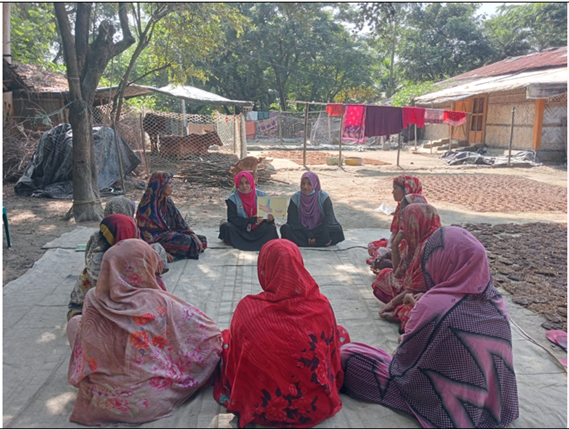
households Figure 1. To ensure effective community penetration,
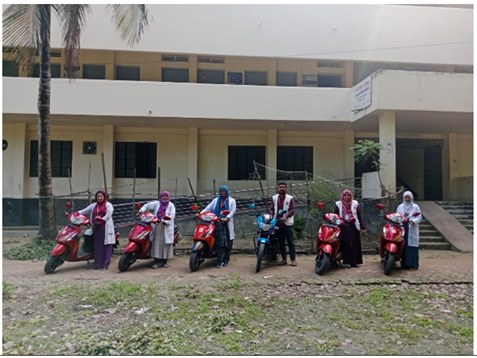
the all-female care providers made a groundbreaking decision: they would learn
to ride scooters. Highly motivated to serve their community, the team learned
to ride within short periods and obtained professional driving licenses Figure 2. As the project's medical officer stated,
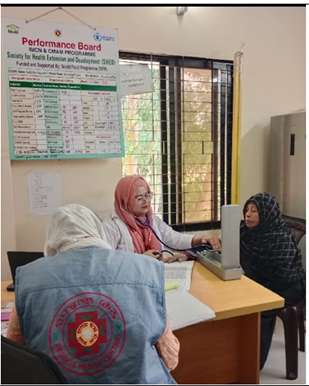
“If a woman truly wants, she can do anything. No obstacle or hardship can stop
her — with determination, she can overcome anything Figure 3.
This act of
teamwork and dedication had an immediate impact. Riding scooters enabled the
female care providers to reach community clinics on time, conduct more field
visits, provide home-based ANC and PNC check-ups for mothers with
complications, and ensure proper follow-up services.
|
Figure 1
|
|
Figure 1 Midwives & Community Health Worker is
Conducting Health Education Session with Women at Kutubdia villages. |
|
Figure 2
|
|
Figure 2 GK-MI Health Team Ready to Go to the
Community |
|
Figure 3
|
|
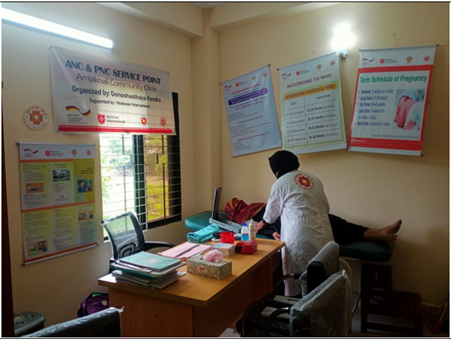
Figure 3 Doctor Consultation Ongoing at the
Community Clinic |
CATALYZING A SOCIAL TRANSFORMATION
The GK women
healthcare providers became change-makers, and their visibility inspired other
women and girls in the community. Notably, a significant number of girls began
riding bicycles to school, emulating the newfound mobility and independence of
their role models.
This increased
community engagement directly translated into improved health outcomes:
·
Antenatal
Care (ANC): The rate of
four ANC visits rose dramatically from 11% in 2022 to 35% in 2025.
·
Postnatal
Care (PNC): PNC
coverage increased from 6% to 24%.
·
Service
Utilization: Outpatient
department (OPD) service usage tripled from 20% to 60%.
·
Awareness: Participation in health awareness
sessions expanded from 25% to 65%, with significant male involvement (source:
project EMR data).
The project
successfully addressed critical service gaps while simultaneously challenging
deep-rooted gender norms. By strengthening women's active participation and
decision-making in health—particularly in ANC, PNC, and Sexual &
Reproductive Health (SRH)—the GK providers built profound community trust and
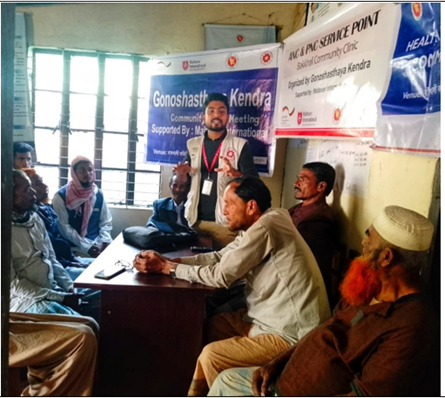
reduced reliance on unsafe traditional practices Figure 4.
|
Figure 4
|
|
Figure 4 Male Partners Engagement in Health
Awareness Discussion Conducting my GK-MI staff |
|
Figure 5
|
|
Figure 5 A Client is
Receiving Health Check-up by Care Provider at Community Clinic |
A REPLICABLE MODEL FOR EMPOWERMENT AND HEALTH
Through persistent
field visits, door-to-door awareness, scooter-based outreach, and engagement
with local leaders, women in Kutubdia have become more informed about maternal
health, nutrition, and hygiene. This has resulted in improved health-seeking behavior
and more timely care.
The project has
transformed both healthcare access and social attitudes. The image of female
health providers riding motorbikes has become a powerful symbol of change,
making healthcare accessible at every doorstep. This community-based model
stands as a replicable milestone for women's empowerment and quality care,
offering a blueprint for other remote, climate-vulnerable regions in
Bangladesh. This success was made possible through the unwavering commitment of
GK's female field staff, the support of GK and MI management, and the
cooperation of the community itself.
ACKNOWLEDGMENTS
We
acknowledge the contribution of Md. Nur A Alam Hira and Dr Jafar Sadeque for
the conceptualization and draft preparation.
REFERENCES
Action Against Hunger. (2017). Health Facility Observation and Assessment Report: Kutubdia Upazila, Cox’s Bazar. ReliefWeb.
Bangladesh Bureau of Statistics. (2022). Population and Housing Census 2022: Preliminary Report. Statistics and Informatics Division, Ministry of Planning.
Gonoshasthaya Kendra. (1972). Gonoshasthaya Kendra. (2026 January 11)
Hossain, M. A., and Akter, M. F. (2019). Comparative Study of High School Dropout Students in Bangladesh: Evidence from Brahmanbaria and Habiganj Districts. Social Change, 13, 22.
Malteser International. (2018). Bangladesh. (2026 January 12)
Razzak, D. A. (2022). Sustainable Microgrid Analysis for Kutubdia Island of Bangladesh. IEEE Access. https://doi.org/10.1109/ACCESS.2022.3164677
|
|
 This work is licensed under a: Creative Commons Attribution 4.0 International License
© ShodhSamajik 2026. All Rights Reserved.